
My dad grew up in Pittsburgh, Pennsylvania, where sports weren’t just a pastime—they were a way of life. His dad’s sister, Clara, was the family’s ultimate fan, cheering loudest for the Pittsburgh Pirates and, surprisingly, for Notre Dame. She’s the one who taught my dad to love the Irish, and when he was just seven years old, he attended his very first Notre Dame game in 1951—fittingly, against the Pittsburgh Panthers.
Fast forward a few generations, and history repeated itself: my son went to his first Notre Dame game at age seven, also against Pitt. Two of my dad’s siblings (and a few cousins) went to Pitt, while my dad and I were the proud Notre Dame outliers. But that’s what makes this rivalry so much fun—it’s rooted in family, full of good-natured ribbing, and built on years of memories that span from one generation to the next. 💚☘️
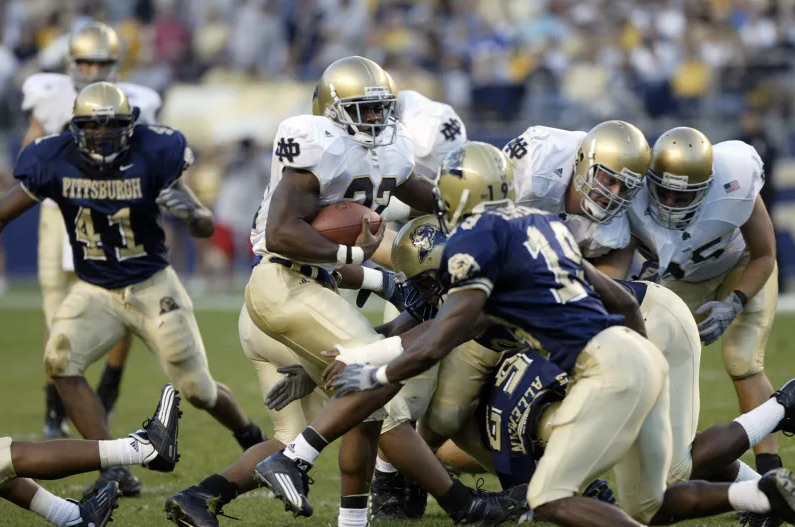
This week, we’re rewinding to another chapter in that storied matchup—the 2003 game in Pittsburgh, when the Irish ground out an unforgettable win in true “gold rush” fashion.
The below excerpt is from the 2003 Notre Dame Football review, published January 29th, 2004, Vol 145, written by Jimmy Atkinson.
Gold Rush
by Jimmy Atkinson
From an offense that had been unsuccessful controlling the football all season, this was a whale of a possession, an epic drive. The Irish offensive line had opened holes all night, but on this possession, they dominated the Panther defense for the final 9: 14 of the game to clinch the 20-14 victory. Pittsburgh’s offense never saw the field again. A 16-play, 68-yard drive consisting of 15 runs was a fitting end to an historic offensive performance for Notre Dame.
“There’s nothing better than having nine minutes left and just keep pounding it down the field until the game is over,” senior offensive lineman Jim Molinaro said.
Senior running back Julius Jones broke Notre Dame’s single-game rushing record by racing to 262 yards on 24 carries. Jones also scored Notre Dame’s only two touchdowns. For an offense that had passed the ball 62 times for 297 yards in a 23-10 loss to Purdue just two weeks prior, the switch to the running game certainly caught Pittsburgh’s defense off guard. The Irish had been ranked 110th nationally in rushing prior to their performance at Heinz Field in Pittsburgh.
“Things opened up for us as a whole team,” Jones said. “The offensive line, I give them all the credit. They stepped up and did a great job.”
The Irish avoided losing their fourth consecutive game, and improved to 2-3 on the season. Pittsburgh moved to 3-2.
Head coach Tyrone Willingham offered an explanation for the switch from a pass-heavy to a rush-heavy offense. “We knew that one of the areas we had been weakest at was running the football,” he said. “So it was a focus of ours to improve that. [It] is exciting for everyone in our program that our offensive line and our backs can take control of the football game and step up and make those plays when necessary.”
Even senior safety Glen Earl had something to say about Notre Dame’s dominating offensive performance. “That was unreal,” he said. “I haven’t seen that in a long time – the offense run the ball at will. That was domination. It was masterful.”
All the rotation along the offensive line finally seemed to have paid off, as this combination contained the chemistry required to push the ball downfield at will. The most significant change on the line was freshman Ryan Harris, who made his first collegiate start at right tackle. Junior offensive lineman Dan Stevenson subsequently was moved to right guard. Harris was able to gain much-needed practice time during the bye week and figured he would get some playing time. It wasn’t until late in the week, however, that he was told that he would start the game. “I actually didn’t find out until yesterday [that I would start,]” Harris said. “Coach said, ‘Did you talk to your parents?’ and I was like, ‘Yeah, I told them I might play a little bit.’ He goes, ‘Well call them, because you’re going to start.'”
It was a surprisingly dominant performance for the offensive line in Pittsburgh. The defense also stepped up to contribute to Notre Dame’s win. After catching his second touchdown pass early in the second quarter to give Pittsburgh a 14-7 lead, the Panthers’ standout wide receiver Larry Fitzgerald was held in check by Irish senior cornerback Vontez Duff for the second half. “[Duff] did a great job in the second half [covering Fitzgerald],” defensive coordinator Kent Baer said. “I was proud of what he did. I’m proud of the whole team.”
Fitzgerald finished with only 79 yards on five receptions and failed to catch a single pass after halftime. Pittsburgh quarterback Rod Rutherford, the nation’s leading passer at the time, completed only 12 of 30 passes for 167 yards and was sacked eight times. The Irish defense did not allow another score after falling down 14-7 early in the second quarter. “It helps a lot when they’re getting that pass rush,” Duff said. “It’s all a team effort.”
Jones answered Fitzgerald’s touchdown with one of his own, a 49-yard run to tie the game at 14-14 with 8:54 in the second quarter. Junior kicker D.]. Fitzpatrick, who had missed his first field goal from 52 yards, came off the bench in relief of injured senior kicker Nick Setta to hit from 19 yards out to give the Irish a 17-14 halftime lead. Fitzpatrick struck again in the third quarter, this time from 32 yards, to give the Irish a 20-14 advantage that eventually became the final score.
Defensive coordinator Kent Baer admitted that this was the best offense that the Irish had faced so far this season, but simply good technique and a ferocious pass rush led to Notre Dame’s ability to stifle any Pittsburgh scoring attempt after halftime. Junior defensive end Justin Tuck recorded 10 tackles, including 3.5 sacks.
With good reason, the entire Irish coaching staff was proud. Already staring a three-game losing streak in the face, a trip to meet the 15th-ranked team in the nation on the road could have proved ultimately disastrous for Notre Dame’s season. But the win promised to perhaps turn the team around just in time for its annual battle with Southern Cal. Notre Dame left Pittsburgh with a 2-3.record, but also with a renewed sense of self-confidence and purpose as they headed back home to clash with the Trojans.
“You would like to hope [that this game will be a turning point],” senior linebacker Courtney Watson said. “[We want] to go out [next week] and just playas great as we did [tonight] and be able to build off of that, to not slip for next week.”
For a team searching for its footing, Notre Dame’s 2003 victory over Pitt was more than just a win—it was a statement. Behind a record-breaking performance from Julius Jones, a relentless offensive line, and a defense that shut down the nation’s top passer and one of its best receivers, the Irish rediscovered their identity.
It was the kind of gritty, determined football that reminded fans why Notre Dame never backs down—whether it’s against a ranked opponent, a family full of Pitt grads, or the odds themselves. My dad would call it classic Irish heart. And just like that, another Notre Dame-Pitt memory was added to our family’s story—proving once again that some rivalries are about more than the scoreboard. They’re about tradition, pride, and the generations who keep cheering, “Go Irish, beat Pitt!”
Cheers & GO IRISH!




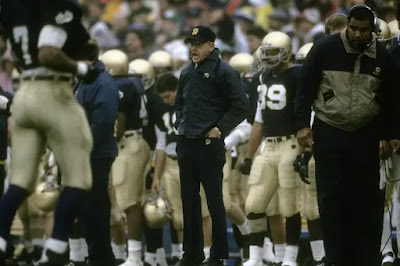
The generational rivalry between Notre Dame and Pitt adds a rich layer of history to college football. It’s fascinating how family legacies shape sports narratives over time.