Every season has a moment when everything hangs in the balance—when confidence wavers, pressure mounts, and belief is tested. In 1943, that moment arrived when Notre Dame lined up against an Iowa Pre-Flight team that hadn’t forgotten the past and had no intention of backing down.
What unfolded wasn’t simply a matchup of unbeaten teams or a battle for national prominence. It was a reminder that great programs are defined by how they respond when momentum slips away. Bill Carey’s account captures a game shaped as much by memory and motivation as by yards and points—a contest that demanded patience, resilience, and faith in what had been built long before kickoff.
The following excerpt is from the 1943 Notre Dame Scholastic Magazine, Football Number, Vol. 80, No. 4, December 10th, 1943, written by Bill Carey.
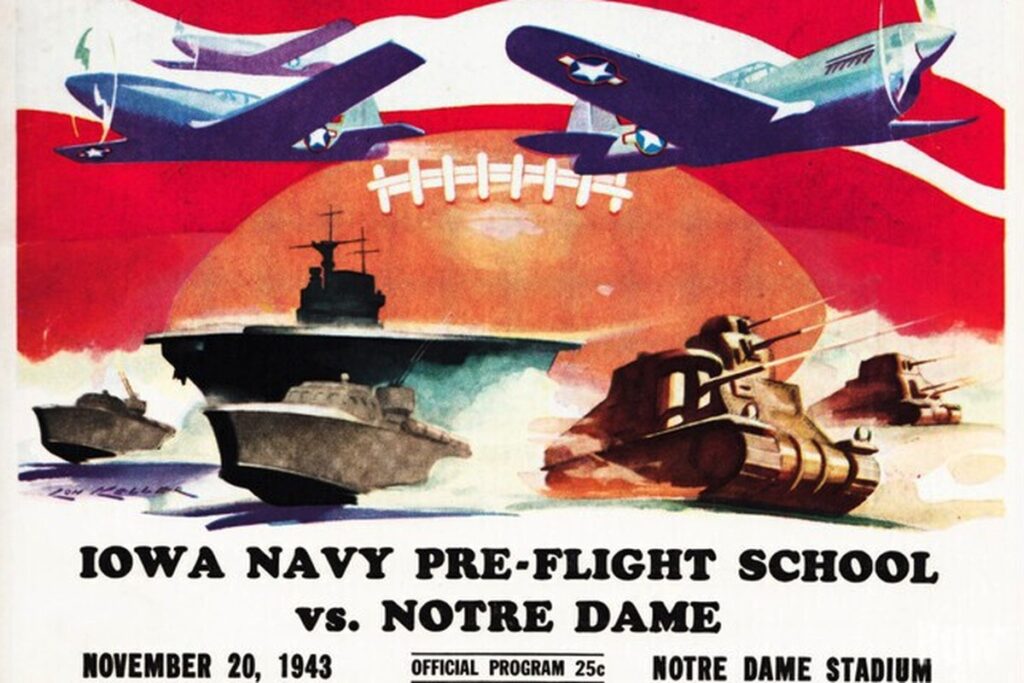
Notre Dame 14, Seahawks 13
by Bill Carey
The gridiron world turned toward the campus of the twin lakes when Notre Dame squared off with Iowa Pre-Flight to decide the National Championship. Both clubs proudly waved eight victory pennants. Each had readily trampled inferior opponents and chalked up basketball scores on one side of the ledger. In the national ranking, number one was meeting number two inside the same chalk lines.
Coached by canny Lt. Don Faurot, ex-Missouri mentor, the Hawks’ lineup sparkled with some of modern football’s greatest names. Ex-professional stars who had been the best in the “play for pay” loop spiced the Navy eleven with the maturity that made them a rough and foxy foe.
This, however, was more than a football game. It was the reflection of a memory—a biting memory for the Seahawks. Eyes ablaze, they looked back to 1942, to the Golden Dome, a 28–0 defeat, to shattered hopes of country-wide dominance. For a year the sailors had pointed to this, the day of reckoning when they might knock Notre Dame from the pinnacle—the pinnacle they once occupied themselves. It was the greatest pigskin event in 1943: two undefeated, untied behemoths slugging it out for glory before 50,000 fans.
Notre Dame kicked off, only to be chilled by a quick Iowa touchdown. Two coffin corner punts spaded the Irish on the lip of their own end zone. On the ND ten, Ensign Art Guepe scampered through a cavity at right tackle to score. Bernie McGarry sliced the extra point through the sticks.
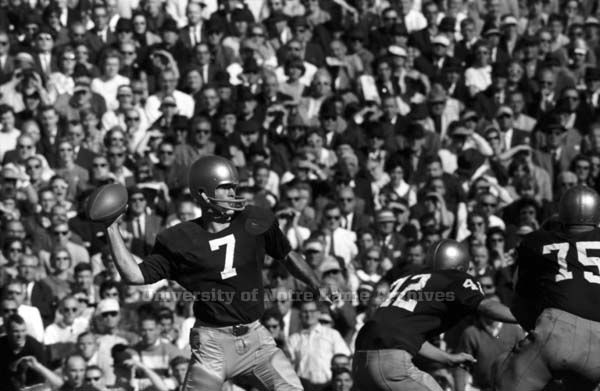
Notre Dame was behind for the first time in nine games. The Irish roared back in defiance—but meekly. The Seahawks once again powered down the field, only to be held on downs on the Irish 13. With but two minutes of the half, a Lujack-to-Yonakor pass covered 50 yards, and another to Kelly reached the three. The next second the gun barked out the finish of the march.
The Irish—the Fighting Irish of Notre Dame—would not admit defeat. They had just begun to fight. After the opening kickoff of the second half, Mello, Miller, Rykovich, and Lujack squirmed and smashed their way down to the Navy 17. A completed aerial, Lujack to Kelly, ate up 13 yards, and Bob then battered his way over from the four. Still one point shy of a deadlock, youthful Freddie Earley calmly toed the telling placement.
After an exchange of punts, the green marched to the Iowa 18, from which point the Seahawks bounced back all the way to the ND six-yard stripe. The line held, but an Irish bobble on the 13 gave the Sailors their break. On the first play, Dick Todd, spectacular halfback of the visitors, rifled a shot to Burk, who toppled backwards into the end zone.
Shocked, the Irish remembered tradition and battled back. With the ball back in their possession, they powered down the white stripes to the six-yard line, where Creighton Miller slashed over for the tying six-pointer.
The scoreboard read 13–13 as Freddie Earley, for the second time, converted what proved to be the margin of victory.
Looking back more than eight decades later, this game still feels familiar. Not because of the uniforms or the names on the roster, but because of the pattern it follows—get knocked down, answer the challenge, and trust that preparation will meet opportunity when it matters most.
The scoreboard may read Notre Dame 14, Seahawks 13, but the deeper takeaway lives beyond the numbers. It’s another reminder of why these stories endure, why they’re worth revisiting, and why the Fighting Irish legacy has always been about more than winning—it’s about responding when the moment asks the most of you.
Cheers & GO IRISH!