This week, I had the chance to speak with longtime Notre Dame athletic trainer Mike Bean about a problem he spent decades watching athletes struggle through—and the solution he eventually built himself.
After 36 years with Notre Dame student-athletes across baseball, men’s and women’s soccer, hockey, tennis and for the last 30 years football, Bean had seen just about every version of an ankle injury imaginable. He’d also seen the limitations of how those injuries were treated.
“Ankle injuries and ankle recovery have always been a major obstacle for athletes,” Bean said. “We had options to protect the ankle from spraining, or treat it after a sprain—but I always felt there had to be a better way than what we were doing.”
That belief stayed with him throughout his career.
A Problem That Wouldn’t Go Away
Bean’s path to Notre Dame began after completing his master’s degree in sports medicine at Western Michigan University, followed by a 10-month internship with Notre Dame’s sports medicine staff. That internship turned into a full-time role—and eventually a 36-year tenure on the Irish sidelines.
During that time, ankle injuries remained one of the most persistent challenges he faced.
“Low ankle sprains are one thing, but high ankle sprains are much more problematic,” he explained. “If they’re severe enough, they can even require surgery.”
Traditional treatment options presented their own issues. Braces were worn directly on the ankle, forcing athletes to squeeze both foot and brace into a shoe that was never designed to accommodate both.
“That compromises the integrity of the shoe,” Bean said. “And once again, I kept thinking—there has to be a better option.”
From Idea to Innovation
Around 2009 or 2010, Bean decided to act on that instinct.
“I started putting some ideas down on paper,” he said. Working with a local orthotist in South Bend, he began the long process of turning concept into reality. It took several years of refinement, but eventually, they had something that worked.
That something became the TayCo Brace.
Visually, it immediately stood apart from anything else on the market.
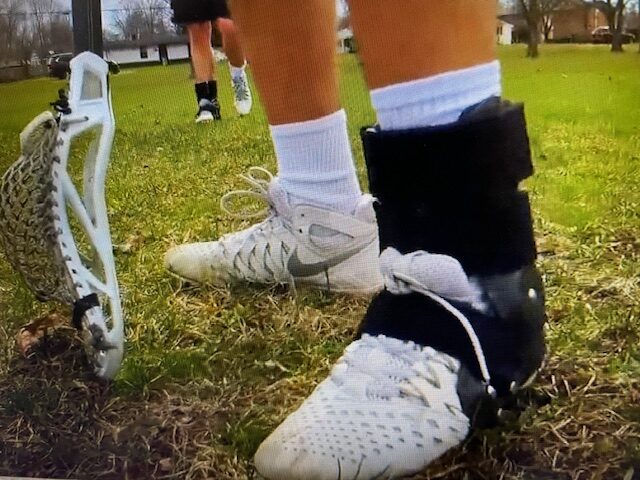
“First off, our brace goes over the shoe,” Bean said. “That alone sets it apart from most ankle braces out there.”
But the design wasn’t just about looking different—it was about function.
“I wanted something that would support the ankle without compromising the shoe,” he explained. “And I wanted people to be able to wear their orthotics too.”
By placing the brace over the shoe or cleat, the TayCo Brace provides stability while allowing the foot to function naturally inside footwear designed for movement. It also offers multidimensional support.
“I wanted to support more than just one part of the ankle,” Bean said. “The ankle, the heel or hindfoot, and the midfoot. Supporting all of those areas is a huge benefit.”
That design is especially important for high ankle sprains, which affect rotational movement.
“Our brace minimizes that rotation so the injury can heal safer and quicker,” he said.
Confidence Matters
While Bean is quick to point out that no brace replaces proper treatment and rehabilitation, he believes the TayCo Brace plays a critical role in restoring confidence—something that’s just as important as physical healing.
“The brace isn’t the savior,” he said. “The athlete still has to rehab. The ankle has to get stronger. Swelling has to come down safely.”
What the brace does provide is the ability to return to normal movement patterns almost immediately.
“They can walk with a normal gait pattern pretty much from the beginning, and pain-free,” Bean said. “That allows them to retain strength while they heal.”
Just as important, it removes fear.
“It gives them confidence that their ankle isn’t going to give out,” he explained. “It takes away the fear of reinjury before they’re fully back to strength.”
Whether it’s planting during a football play or sprinting down the first-base line, that confidence can make all the difference.
A Shift in How Injuries Are Managed
From a trainer’s perspective, Bean believes the TayCo Brace has changed how ankle injuries are managed altogether.
“Ankles are meant to move,” he said. “The first thing we want to do with an ankle injury is get you moving.”
Traditional walking boots often limit that movement—but they also create new problems.
“When you put someone in a walking boot, it raises one hip higher than the other,” Bean said. “That can lead to hip or back injuries, and muscle atrophy.”
Because the TayCo Brace allows normal gait and movement, athletes can maintain strength and progress into advanced rehab sooner.
“It gets you back into your activities as quickly—and safely—as possible,” he said.
Trust Built Over Time
Like many athletic trainers, Bean was used to fabricating braces and splints as part of the job. Introducing the TayCo Brace followed that same organic path.
“We tried it in practice for quite some time before ever using it in games,” he said. “We had really great success, and it just kind of snowballed from there.”
Soon, athletes were asking for it by name.
“Now I’ve got guys coming into my office saying their ankle hurts and asking if they can use one during practice,” Bean said.
That trust eventually extended far beyond Notre Dame—into collegiate and professional sports nationwide.
Seeing the brace highlighted on ESPN during a recent pregame broadcast was a moment that caught even Bean by surprise.
“I thought, wow—that’s some cheap advertising,” he joked. “But it was really gratifying to see people taking notice.”
Beyond Athletics
What Bean never anticipated was how far beyond athletics the brace would reach.
In 2016, he partnered with Dr. Fred Ferlic of South Bend Orthopaedics, who shared Bean’s frustration with walking boots and saw the potential for something better.
Together, they expanded the TayCo Brace into multiple versions: for military training, workers wearing steel-toed boots, senior citizens with ankle instability, post-surgical rehab patients, and even individuals with neurological disorders.
“We’ve used it with patients with Guillain-Barré syndrome,” Bean said. “It’s helped preserve their gait and prevent their ankles from buckling.”
The feedback has been overwhelming.
“Hearing from people who were homebound and can now get out and walk safely—that’s what really moved the needle for me,” he said. “Helping people get back to their lives is why we do this.”
A Legacy Beyond Sports
While seeing the TayCo Brace used in the NFL, college athletics, and high schools is gratifying, Bean says those moments pale in comparison to something much simpler.
“Seeing an elderly man or woman able to go to the grocery store again—that’s the most gratifying thing for me,” he said.
Even the name of the brace reflects how personal the journey has been.
“It comes from my family,” Bean said. “Tay is from my oldest daughter Taylor, and Co is from my wife Colleen and my youngest daughter Courtney.”
For a man who spent his career quietly helping athletes recover behind the scenes, the TayCo Brace represents something bigger than innovation.
It represents a lifetime spent asking one simple question—and refusing to stop until he found the answer:
There has to be a better way.
For a man who spent 36 years serving Notre Dame student-athletes, it feels fitting that Mike Bean’s most lasting impact extends far beyond the sidelines. The same care, patience, and athlete-first mindset that defined his time in the training room now lives on through the TayCo Brace—helping people of all ages return to movement, confidence, and independence. It’s a reminder that some of the most meaningful contributions to the game aren’t made under the lights, but in the quiet work of helping others heal.
You can learn more about the TayCo brace here: Keep Your Shoes with TayCo Brace – Walking Boot/AFO Alternative
Cheers & GO IRISH!